
 0
0
 0
0
Nigeria’s political history since the return to civilian rule in 1999 has produced a curious and troubling pattern – one that is rarely acknowledged openly but is nonetheless visible to anyone who cares to observe it. Each presidential era appears to generate its own emblematic detainee: an individual whose prolonged confrontation with the state becomes a symbolic drama through which political power announces itself.
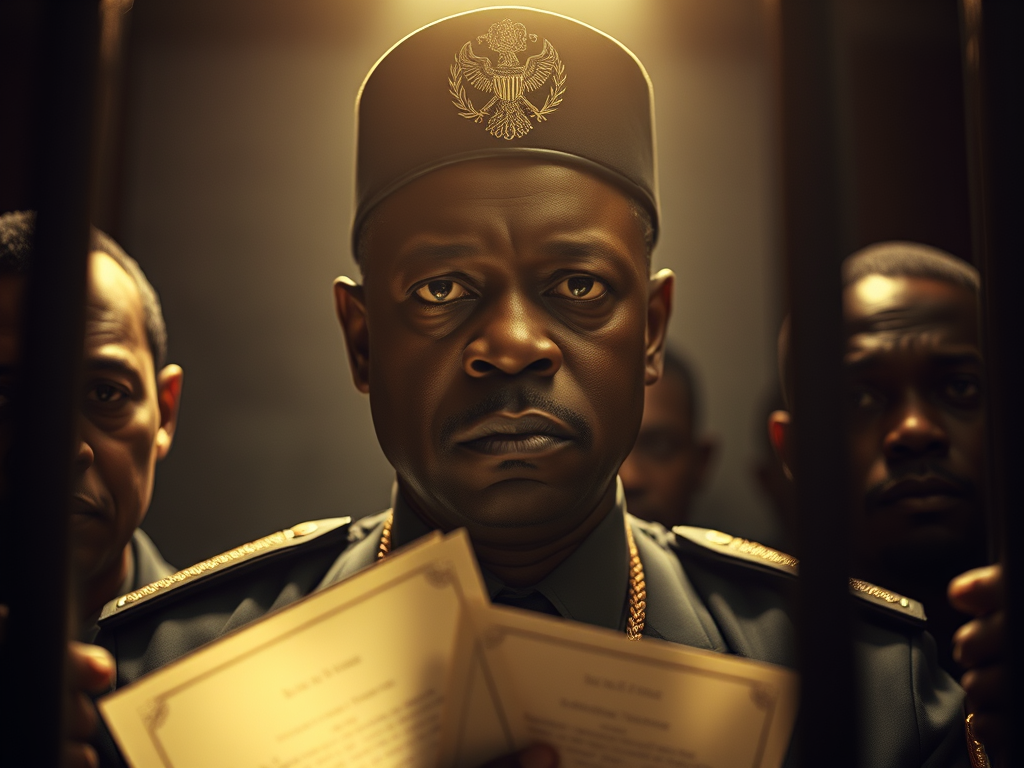
These detainees are rarely ordinary criminals. They are almost always individuals who once occupied the inner sanctums of power – security chiefs, senior officials, political heavyweights or influential insiders whose fall from grace becomes a spectacle. Their detention becomes not merely a legal matter but a political statement. The Nigerian state, it seems, periodically requires a prisoner through whom authority can be dramatized.
Under the presidency of Olusegun Obasanjo, that symbolic figure was Hamza Al-Mustapha, the powerful Chief Security Officer to the late military ruler Sani Abacha. When Nigeria returned to civilian rule in 1999, the Abacha era was considered a dark and controversial chapter, by some, in the national memory. There was enormous political pressure on the new democratic government to demonstrate that the abuses of the military era would not simply disappear into history without accountability.
In that atmosphere, Al-Mustapha became one of the most visible embodiments of the Abacha regime. His arrest and prosecution were therefore laden with symbolism. Yet what followed soon began to raise uncomfortable questions.
For years, Al-Mustapha remained in detention while his case drifted endlessly through Nigeria’s judicial system. Adjournments piled upon adjournments. The prosecution appeared to struggle in assembling a case that could withstand judicial scrutiny. Witnesses changed testimony. Narratives shifted. What should have been a straightforward criminal proceeding evolved into an interminable legal odyssey that spanned almost the entirety of Obasanjo’s presidency.
The impression gradually formed that the state had made a political decision that Al-Mustapha must remain in custody, even if the legal architecture required to sustain that detention remained fragile. It was not until the administration of Goodluck Jonathan that the courts eventually concluded the matter, overturning his conviction and setting him free. After more than a decade of incarceration and litigation, the case that had once appeared so politically indispensable ultimately collapsed.
The next cycle emerged during the presidency of Muhammadu Buhari. This time, the focal point was Sambo Dasuki, a man who had once occupied one of the most sensitive positions within Nigeria’s security architecture. Dasuki was accused of presiding over the diversion of billions of dollars meant for arms procurement in the war against insurgency. The allegations were serious and demanded judicial scrutiny. Yet the manner in which the case unfolded raised troubling constitutional questions.
Multiple courts granted Dasuki bail. Yet he remained in detention for years. Court orders were issued and quietly ignored. Legal rulings accumulated without practical effect. The spectacle that unfolded was extraordinary: a constitutional democracy in which the judiciary continued to pronounce itself while the executive branch behaved as though those pronouncements were optional. The implications were profound. When a government selectively obeys court orders, it subtly reintroduces the logic of authoritarian rule into a democratic framework.
Thus Dasuki became the emblematic detainee of the Buhari era – not simply because of the accusations against him, but because his prolonged detention symbolized the uneasy relationship between executive power and the rule of law.
Now, under the presidency of Bola Ahmed Tinubu, there are growing indications that the pattern may once again be repeating itself. This time the political tensions appear to be converging around Nasir Ahmad el-Rufai, one of the most intellectually assertive and politically polarizing figures within Nigeria’s contemporary elite.
El-Rufa’i is no stranger to controversy. Over the past two decades he has cultivated a reputation as both reformer and provocateur, admired by some for his bluntness and administrative zeal, and criticized by others for the same qualities. Yet what makes his current predicament particularly striking is that he was once a central figure within the very coalition that produced the present political order.
But Nigerian politics has always been unforgiving toward former insiders. The closer one stands to power, the more dangerous the fall can become. If the current tensions continue to escalate, Tinubu’s administration may well find itself reproducing a familiar Nigerian ritual: the transformation of a former ally into the defining adversary of the state.
Yet focusing solely on these personalities risks missing the deeper structural problem. The issue is not simply that certain individuals have found themselves detained under successive administrations. The deeper issue is that Nigeria’s political culture appears to require these symbolic confrontations. Behind this pattern lies a disturbing institutional habit: the tendency of governments to search for evidence after political decisions have already been taken.
In an ideal legal system, evidence precedes prosecution. Investigators gather facts, prosecutors assess their strength, and only then does the machinery of the state move toward charges and detention. In Nigeria, however, the sequence is often reversed.
Once a political decision has been made that a particular individual must be neutralized, the investigative process sometimes becomes a desperate search for facts capable of justifying that decision. Investigations transform into fishing expeditions. Witnesses are pressured or incentivized. Documents are interpreted creatively. Narratives are constructed first, while evidence is expected to catch up later.
This inversion of the legal process inevitably produces weak cases and prolonged trials. When the evidence is fragile, cases stretch across years because the state is struggling to assemble the factual scaffolding necessary to sustain its accusations. The result is a peculiar spectacle in which detention becomes the punishment long before any conviction is secured.
In this sense, Nigeria has gradually evolved what might be described as a political economy of detention. Each administration produces a figure whose confrontation with the state serves as a warning to others. The detainee becomes a political symbol – a reminder that the instruments of coercion remain firmly in the hands of those who control the state.
But the long-term consequences of this practice are deeply corrosive. It weakens the credibility of anti-corruption campaigns by making them appear selective. It erodes public confidence in the judiciary by demonstrating that court orders can be ignored. And it reinforces the perception that Nigeria’s legal system can be bent to serve political convenience.
A democracy that relies on symbolic prisoners to demonstrate authority is a democracy that has not yet fully internalized the rule of law. Strong states do not need exemplary detainees. Their legitimacy flows from institutions that function predictably – prosecutors guided strictly by evidence, courts capable of delivering timely justice, and governments that respect the limits imposed by the constitution. Until Nigeria achieves that institutional maturity, the cycle will likely continue.
One administration will depart, another will take its place, and somewhere within the political landscape a new figure will emerge to occupy the familiar role – the detainee whose prolonged struggle with the state becomes the defining political drama of an era.
The tragedy is that the system does not merely produce prisoners. It needs them.


